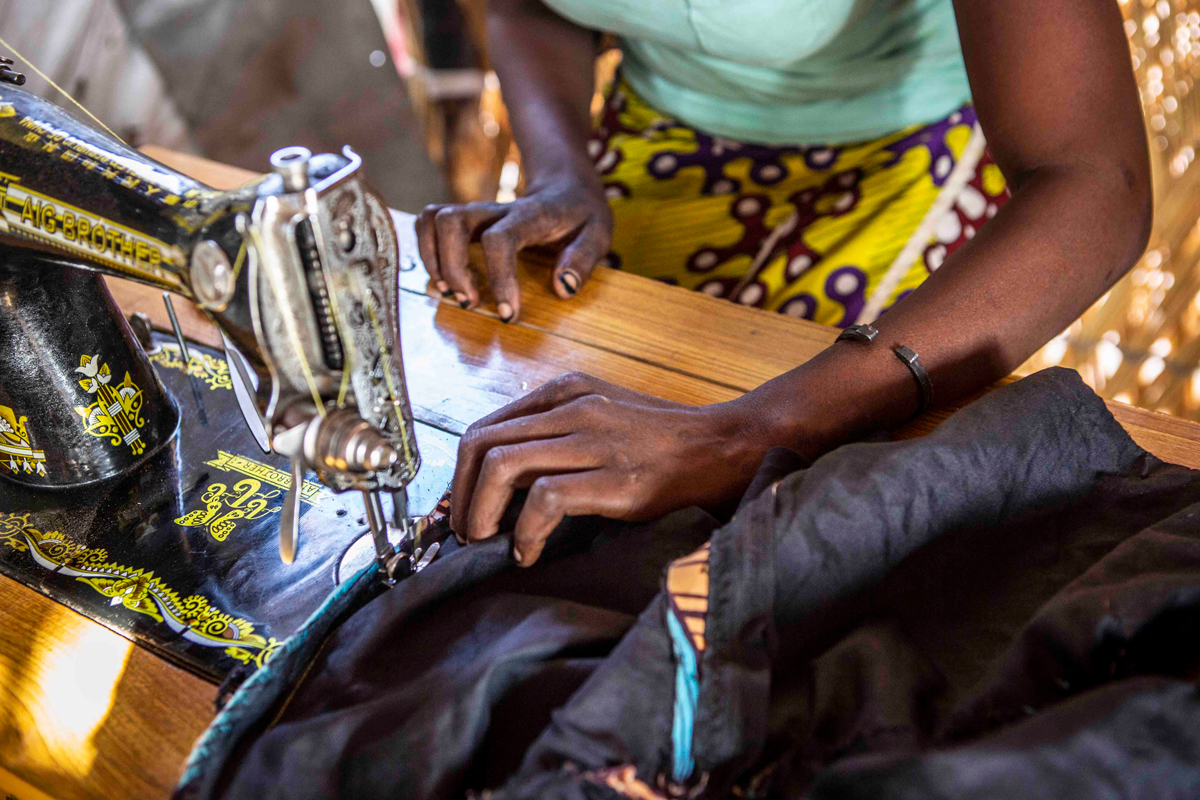
“Every time I sit in front of my machine, I forget everything.”
"My grandmother hid my sister and me, but they found us." When Boko Haram came to her village, they left with 300 girls. Habiba was 12 years old. "They asked us to marry them, or they would kill us or make us their slaves."
Habiba refused. She ran away. On three occasions, her escape attempts fell short, andthe punishment equaled her courage and determination. When they took her back, she had no choice: "They just told me I was married. I hadn't even seen this man. They covered me from head to toe so that no one would look at me."
Marriage, the promise of a new life. Here was an initiation, a rite of passage tinged with mysticism designed to chisel away at Habiba's sense of belonging and self.
"Elephants never turn their back; they only go forward. So they made us drink their blood to materialize that we will never look back, to our past, to those we left behind."
The extremists moved her to a new location. "In the forest, there was a hole in the ground; they made us go down with ropes." Habiba descended underground as if into a grave, the earth closing in on her. There, she discovered a brand new world. "It was a whole community, with houses, rooms, families, babies. People who spoke other languages, with different skin colors."
Violence was imprinted in the walls and in words. "There were surveillance cameras outside to watch for possible army incursions. The fighters were covered with knives that they never left, even to sleep. Before going out, the prayers would end with 'may we survive or die,' and then birds would be released. When we saw the birds come back, we knew they were coming back too."
After her three escape attempts, Habiba retreated into her life. Reunited with her mother, Habiba entrenched herself behind a shield of silence. "I stayed for four years without talking to anyone. After what I went through, I just couldn't."
Last year, she benefited from a UNICEF-funded project for reintegrated children associated with armed groups. At first, the project addressed her trauma. Gradually, the shield cracked. Among other things, "They gave us writing materials. Whenever I'm upset, I write. It makes me feel better, helping me deal with the stress. I started sitting with people again, talking."
Habiba also received an apprenticeship in sewing and money to buy the tools that she needed to start her business. Like the thousands of makeshift shelters in the city of Maiduguri, her straw and canvas workshop is beginning to attract customers. "They ask me to make clothes for them, especially during the celebrations".
Enveloped by its gentle rumble, her hands in motion, the machine brings her back to the present. "Every time I sit in front of my machine, I forget everything. I don't think about anything else." In the midst of those who have nowhere else to go but still celebrate life's most precious events, Habiba is creating a new haven for herself.